1. What is Off-Page SEO
Off-page SEO is the practice of making your website appear high in the search engine results. It includes link building, brand mentions, guest posting, digital PR, and social sharing.
Many beginners believe that SEO is mostly about producing optimized content. But this is just one step in the complete process.
Search giants like Google also observe the behaviour and engagement of other sites with yours.
For example, if other sites are adding the links to your content on their site, it gives a green signal to Google that your content is helpful and provides value to the reader. They are linking back to your content as a source of reference.
2. Common Off-Page Mistakes and How to Avoid Them
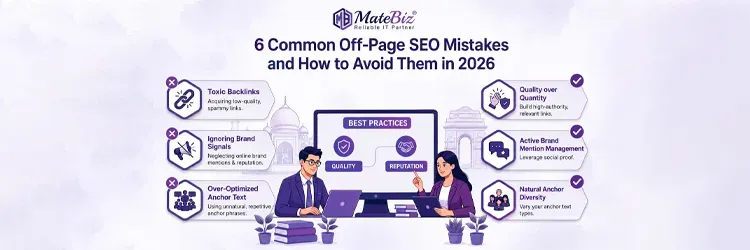
Many beginners put effort into off-page SEO. But do not get the expected results. The reason is often some common mistakes that hurt their SEO efforts. Here are six mistakes to avoid:
2.1) Chasing Link Quantity Instead of Quality
Beginners believe that their sites will rank higher if they get lots of backlinks. So, they just try to get as many links as they can. They do not think about the quality of backlinks.
But that’s not how link building works in 2026. A lot of low-quality backlinks may not add much value to your website. Sometimes they even hurt your SEO efforts.
One backlink from a high-domain-authority website can be more valuable to your website than many other links from websites with low domain authority.
As such, you need to determine the domain authority of the website before engaging them for backlinks. For example, Prepostseo is an excellent platform to measure the domain authority of a site. Some other SEO parameters provided by Prepostseo include domain age, page authority, and spam score.
Generally speaking, the higher the DA score, the stronger the backlink profile of the site. Also, a site with more authoritative backlinks can provide the greatest value to your site.
2.2) Using Spammy or Paid Link Schemes
Many website owners want fast SEO results. As a result, they buy backlinks or get involved in link schemes that promise hundreds of links within days.
The problem is that these links are often built from spammy sites. Such sites are created solely to manipulate rankings. Search engines are much better at finding these practices.
When a new site gets too many backlinks within a few days, it signals search engines that the links are not natural but gained through a paid linking scheme. Google marks the site involved in link manipulation.
So it’s better to focus on getting links naturally by providing useful content and guest posting.
2.3) Repeating the Same Anchor Text
Some beginners intentionally make this mistake. They think getting backlinks on one anchor text will help their site rank on that keyword. But this is not true until you are getting links to your brand name.
Repeating the same anchor text on multiple backlinks signals that the same person is intentionally getting links. Google sees it as link manipulation.
Therefore, you need to maintain a diverse anchor text profile. Branded anchors, partial match keywords, and natural phrases are some options to use. This creates more natural backlinks and reduces the risk of over-optimization.
2.4) Building Links from Irrelevant Niches
Another mistake that is common is getting backlinks from websites that have no relevance to your niche.
A backlink from a car parts website is not very helpful if you have a fitness blog. Google determines if the site pointing to you is relevant to your content.
Irrelevant links serve no purpose, appear strange, and even cause harm to your site. Always seek backlinks from sites within your niche or something very relevant. A few relevant links are far more powerful than a lot of random links from unrelated niches.
2.5) Ignoring Brand Mentions Without Links
Many beginners are chasing new backlinks and ignoring existing brand mentions that don’t have a link. There are still missed opportunities when a blog or news site mentions your brand name but doesn’t link to you. Google considers brand mentions a trust signal even if they’re not linked.
These unlinked mentions are easier to convert than building a fresh backlink because the writer already showed interest in your brand once. A simple email asking them to add a link usually works. One converted mention can bring more value than chasing a brand-new backlink from a stranger.
2.6) Lack of Diversity in Link Building
Link building from one particular source only is a common error made by beginners. Maybe it’s all guest posts or just directory submissions. Google notices this pattern, and it looks unnatural compared to a normal backlink profile.
A natural backlink profile has links coming from different places. Mixing these sources makes your link profile look like it grew organically over time, not through one repeated tactic.
4. Everything You Need to Know About Off-Page SEO in 2026
- Why is off-page SEO important for improving rankings?
Off-page SEO helps search engines understand how trustworthy and authoritative your website is based on external signals like backlinks, brand mentions, and social signals, which directly influence your ability to rank higher in competitive search results.
- What makes a backlink high quality?
A high-quality backlink comes from a relevant, authoritative, and trusted website. Factors like domain authority, content relevance, organic traffic, and low spam score determine how valuable a backlink is for improving SEO performance.
- What are unlinked brand mentions in SEO?
Unlinked brand mentions occur when your brand is referenced online without a clickable link. These still act as trust signals and can often be converted into backlinks by requesting the publisher to add your website link.
- How can businesses improve off-page SEO?
Businesses can improve off-page SEO by focusing on local citations, earning quality backlinks from relevant websites, building brand mentions, and engaging in authentic digital PR strategies tailored to their target audience.
- Why should anchor text be diversified?
Using varied anchor text helps maintain a natural backlink profile. Overusing exact-match keywords can look manipulative to search engines, while a mix of branded, generic, and partial-match anchors appears more organic and safe.





 Saddam Irshad
24/06/2026
Saddam Irshad
24/06/2026