Search engine optimization has undergone a dramatic transformation over the last time. An era when getting discovered by Google was all about identifying the right keywords, inserting them in your article, setting up backlinks, and then waiting for the results. Although keywords are important, they really are not the key to a successful SEO campaign anymore.
Google had evolved into a much better understanding of context, users and the actual intent of each search query in 2026. This change has given rise to the concept of search intent as one of today’s most impactful ranking signals for SEO.
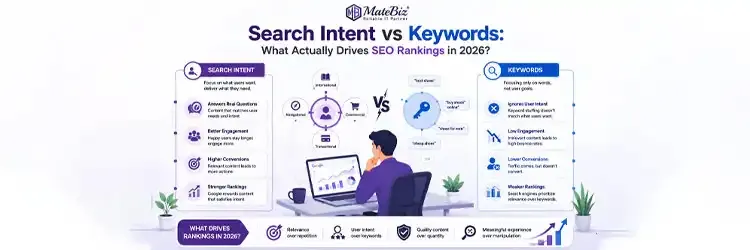
Explaining that modern SEO is about helping search engines understand and serve valuable content, not just matching keywords.
So, does this mean keywords are no longer important? Not at all. The true question isn’t about search intent or keywords; it’s how these two elements are interwoven together to produce a sustainable approach to SEO success.
Discover How Matebiz Can Help
1. What Are Keywords in Modern SEO?
Keywords are the basis of any SEO strategy as they are the terms that people enter into search engines. They assist Google in determining what a page is about, and also help businesses understand what topics that their customers are searching for. Today, keyword research goes far beyond finding high-volume search terms.
Different keyword types on which modern SEO focuses include:
- Primary keywords that define the main topic
- Secondary keywords that support the primary topic
- Long-tail keywords targeting highly specific searches
- Semantic keywords that help Google understand context
- Question-based keywords commonly used in voice and AI searches
For example, if your primary keyword is “digital marketing agency,” related keywords might include:
Rather than repeating the exact phrase multiple times, Google’s algorithms now recognize relationships between these terms, allowing content to rank for hundreds of related searches.
This means keyword optimization is no longer about density, but it’s about relevance.
2. What Is Search Intent?
Search intent refers to the reason behind a user’s search. It answers one important question:
“What is the user actually trying to accomplish?”
Google’s primary objective is to deliver the most helpful result based on that intention, not simply the page containing the exact keywords.
There are four primary types of search intent.
- Information intent
- Navigational intent
- Commercial investigation
- Transactional intent
Understanding these distinct intent types allows businesses to create content that is appropriate for each phase that buyers go through.
Search Intent vs Keywords: Understanding the Difference
Although they are closely related, keywords and search intent serve different purposes.
| Keywords |
Search Intent |
| Identify what users search for |
Explains why users search |
| Focus on words and phrases |
Focuses on user goals |
| Guide topic selection |
Shapes content structure |
| Helps Google categorize pages |
Help Google measure relevance |
| Increase discoverability |
Improve user satisfaction |
Think of keywords as the destination and search intent as the reason for the journey.
Keywords will help Google understand the content of your website, while search intent may give Google an idea about how valuable your website is for ranking purposes.
For example, someone searching for “SEO audit” may want:
- A free SEO audit tool
- An explanation of SEO audits
- An agency to perform one, or
- A downloadable checklist
Although keywords remain the same, the user’s intent varies, making search intent understanding essential for creating content that truly satisfies searchers.
Request a Free SEO Audit
3. Why Keywords Alone No Longer Guarantee Rankings
Google’s search algorithms have become remarkably sophisticated.
Instead of rewarding pages that simply repeat keywords, Google evaluates whether users actually find the content useful.
Several factors have contributed to this shift.
3.1 AI-Powered Search
Artificial intelligence enables Google to comprehend naturally spoken language, synonyms and even conversational queries. This implies that the pages are going to be ranked even without having an exact keyword match, provided that they can respond to the question properly.
3.2 Semantic Search
Google recognizes the connections between entities, topics and concepts. An extensive article on SEO will naturally include words such as backlinks, content marketing, technical SEO, user experience and search intent, without imposing them into the article.
3.3 User Experience Signals
Modern ranking systems look at the way that users interact with websites. If users leave the page immediately since the page’s content doesn’t answer their queries, Google receives a strong signal that the site isn’t delivering on the intent of the search.
Positive engagement often includes:
- Longer time on page
- Lower bounce rates
- Meaningful interactions
- Continued browsing
- Returning visitors
It helps in boosting online presence.
3.4 Helpful Content
Google is increasingly rewarding websites that are skilled and provide unique, practical and useful information instead of publishing content created solely to be used by search engines.
This change has encouraged businesses to invest in quality rather than quantity.
4. How Google Understands Search Intent in 2026
Not all search engines solely depend on keywords. Instead, they make use of different techniques to assess the needs of users.
4.1 Natural Language Processing (NLP)
NLP enables Google to understand how people naturally communicate rather than focusing only on exact keyword matches.
For example, Google understands that:
- best digital marketing company,”
- “top online marketing agency,” and
- “recommended SEO firm”
May all have similar meanings.
4.2 Semantic Understanding
Google identifies related concepts instead of isolated keywords.
An article discussing hybrid vehicles naturally includes topics like batteries, charging, maintenance, energy efficiency, and electric motors because these concepts are connected.
The same principle applies across every industry.
4.3 User Behaviour
Google studies millions of search sessions to determine which pages consistently satisfy users.
If people regularly click a result, stay engaged, and don’t immediately return to search for another answer, that page demonstrates strong intent alignment.
4.4 Content Depth
Content that is comprehensive is typically more beneficial because it gives answers to the questions users are likely to ask.
Rather than publishing several thin articles targeting individual keywords, successful websites create complete resources covering an entire topic.
This approach also strengthens topical authority, which has become increasingly important in competitive industries.
5. Why Search Intent and Keywords Work Best Together
A successful SEO strategy doesn’t replace keywords with search content but combines them in 2026.
Consider keywords as the foundation for the SEO strategy. They will reveal what people are looking for and will help you determine ways to increase organic traffic. Search intent takes the approach to the next level by addressing the reason why people are searching and what they’re expecting to see after examining results.
When keywords and search intent work together, they create content that is:
- Relevant to both users and search engines
- More likely to rank for multiple related search queries
- Better at keeping visitors engaged
- More effective at generating leads and conversions
- Better aligned with Google’s focus on helpful, user-first content
Rather than choosing between keywords and intent, businesses should utilize keyword research to determine what people are searching for, and analyze search intent to figure out what they can do to provide the best possible solution.
6. How to Align Your Content with Search Intent
Understanding search intent is only the first step. The real value comes from applying it throughout your content strategy.
Here are a few practical ways businesses can better align their content with user intent:
Before writing content, review the first page on Google for your desired keyword. The kind of content that ranks at the top can reveal what the users are expecting to get to see.
- Match the Right Content Format
Different searches require different types of content. Informational queries typically perform well with blog posts or guides, while transactional searches are better suited to service pages or product pages.
- Answer User Questions Clearly
Content that is comprehensive and addresses the relevant issues and questions will more likely to please users and boost engagement.
Include primary and secondary keywords where they fit naturally, avoiding unnecessary repetition. Focus on readability rather than keyword density.
- Create Clear Conversion Paths
If users are researching services, provide relevant calls to action, case studies, testimonials, or consultation options that help them take the next step.
Matching the content to users’ intents provides both a better user experience and higher chances of gaining higher ranks and conversions.
7. Best Practices for SEO Success in 2026
With the continuous evolution of search, companies need to adopt SEO services that take into account both visibility and value to the user.
Some of the most effective practices include:
- Begin every content strategy from an intent point of view, not just keyword volume.
- Do your keyword research to know how your audience communicates.
- Develop topical authority by discussing related topics in depth.
- Publish original, experiential content that proves you’re an expert on the subject.
- Increase the speed of your website and make it mobile-friendly.
- Optimize internal linking for both humans and robots.
- Update older content regularly.
- Measure your success based on the results you’re getting, not the rankings.
Businesses that embrace these practices are better positioned to achieve sustainable organic growth as search algorithms continue to evolve.
8. How Matebiz Builds SEO Strategies That Rank and Convert
At Matebiz, we believe successful SEO is about much more than improving keyword rankings. Our strategy is based on understanding users’ needs and creating content that is valuable and creating long-term authority that leads to the growth of your business in measurable ways.
Our AI-driven SEO strategies include:
- In-depth keyword and search intent research
- Technical SEO audits and website optimization
- Content strategies built around topical authority
- SEO-friendly website architecture and internal linking
- High-quality, human-written content
- On-page optimization aligned with Google’s best practices
- Performance tracking and continuous improvement
With 10+ years of expertise, more than 5000 completed projects, and a 95% client retention rate, we have helped businesses across 40+ countries in improving their online visibility and creating qualified leads.
Unlike chasing short-term results in increasing website rankings, we specialize in providing our clients with long-term SEO strategies which are aimed at reaching the right people and gaining their trust and loyalty.
Future-proof your SEO strategy and schedule a strategy call and talk to our specialists!
9. Keywords + Search Intent = SEO Success in 2026
Matebiz, based in Delhi, India, and serving clients worldwide, enables businesses to stay ahead of the ever-changing algorithmic requirements for search engines by using SEO strategies that are designed to ensure long-term success. We recognize that in order to achieve a sustainable ranking in 2026, simply using popular keywords is not enough; we need content that relates to user search queries.
With the help of keyword research and analysis of search intent, we create SEO campaigns that not only improve visibility but also drive quality traffic and enhance conversions. All strategies that we implement, ranging from technical SEO, content marketing, topical authority, and performance measurement, are intended for helping you grow your business.
Ready to build an SEO strategy that actually drives results? Start at $250/month and let’s create a strategy that is built for the future, not the past.
Book Your Free SEO Strategy Session





 Saddam Irshad
03/07/2026
Saddam Irshad
03/07/2026