Website development is moving beyond attractive designs and functionality. In 2027, businesses need websites that are faster, smarter, more secure and capable of delivering a personalised user experience. Technologies such as artificial intelligence (AI), progressive web apps, headless CMS and advanced security solutions are changing how websites are built and managed.
For businesses, keeping up with these changes is no longer just about following trends. Matebiz, a website development company based in Delhi, India, and serving clients worldwide, focuses on building functional, scalable and user-friendly websites that help businesses strengthen their online presence.
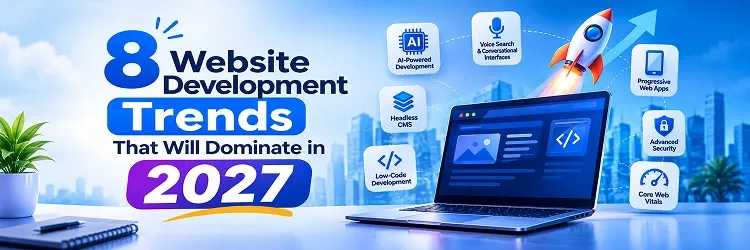
Let’s explore the eight website development trends expected to shape 2027 and what they actually mean for businesses.
Get a Website Development Proposal
1. Key Takeaways
- AI-powered development, conversational interfaces and personalised experiences will shape future websites.
- Progressive Web Apps will improve mobile accessibility, speed and app-like browsing experiences.
- Headless CMS, API integrations and low-code platforms will support flexible website development.
- Motion UI, cybersecurity and Core Web Vitals will influence website performance and user experience.
- Businesses should adopt scalable, secure and user-focused technologies to stay competitive in 2027.
- These trends are especially relevant for businesses, startups and brands planning website upgrades or new development projects.
2. AI-Powered and Adaptive Website Development
AI is making website development faster and more efficient. Developers can now use AI-powered tools to generate code, identify errors, suggest design suggestions and automate repetitive tasks.
In 2027, AI will also play a bigger role in website personalisation. Websites can use visitor behaviour and preferences to recommend relevant products, display personalised content and improve customer interactions.
Business benefit: Faster development, smarter personalisation and more relevant user experiences.
3. Voice Search and AI-Powered Conversational Interfaces
Users increasingly expect websites to provide quick answers without navigating multiple pages. Voice search and conversational interfaces are helping businesses meet this expectation.
Voice-enabled search allows visitors to find information using spoken queries, while AI-powered chatbots can answer questions, guide users and assist with product or service discovery.
Business benefit: Better accessibility, faster customer support and improved visitor engagement.
4. Advanced Progressive Web Apps for Better Mobile Experiences
Progressive Web Apps (PWAs) combine the convenience of websites with several features of mobile applications. They can load quickly, work across devices and offer features such as offline access and push notifications.
Unlike traditional applications, PWAs do not always require users to download an app from an app store. Visitors can access them directly through their browsers, making them convenient for businesses that want to improve mobile experiences.
Business benefit: Faster access, improved mobile usability and wider customer reach.
5. No-Code and Low-Code Development
No-code and low-code platforms are changing how businesses approach website development. These platforms use visual interfaces, pre-built components and ready-to-use integrations to simplify the development process.
While no-code tools require little to no programming, low-code platforms allow developers to add custom code when needed.
In 2027, these solutions will continue to help businesses build websites, launch updates and test new ideas faster. However, complex websites may still require professional coding to achieve the required flexibility and functionality.
Business benefit: Faster development, reduced complexity and easier website updates.
6. Headless CMS and Composable Architecture
Traditional content management systems connect the website’s frontend and backend. A headless CMS separates these two layers, allowing businesses to manage content independently and deliver it across multiple platforms.
With API-first architecture, websites can connect with different applications, tools and services more easily.
For businesses managing websites, mobile applications and other digital channels, this approach offers greater flexibility. It also makes future upgrades and integrations easier to manage.
Business benefit: Better scalability, flexible content delivery and easier integration with digital marketing platforms.
7. Immersive Motion UI and Interactive Experiences
A website should not just provide information; it should make browsing engaging. Motion UI uses animations, transitions and interactive elements to guide visitors and improve the overall browsing experience.
Examples include animated buttons, scrolling effects, interactive product displays and subtle loading animations.
In 2027, businesses will increasingly use meaningful interactions to make websites more engaging. However, animations should remain lightweight and purposeful so they do not affect loading speed or distract visitors.
Business benefit: Improved user engagement, better navigation and more memorable website experiences.
8. Security-First and Privacy-Focused Development
Website security will remain a major priority in 2027 as businesses handle increasing amounts of customer information and online transactions.
Rather than treating security as an after-development task, developers will need to integrate protection into the website development process itself.
90.4% of website requests used HTTPS. Important practices include:
- Implementing HTTPS and SSL certificates
- Using multi-factor authentication
- Keeping plugins, themes and software updated
- Applying secure coding practices
- Performing regular security checks and backups
A secure website protects business information, builds customer confidence and reduces the risk of cyberattacks.
Business benefit: Better data protection, reduced security risks and stronger customer trust.
9. Core Web Vitals and Performance-Driven Development
Website speed and performance directly influence how visitors experience a website. Slow-loading pages, delayed interactions and unstable layouts can frustrate users and increase abandonment.
Google’s Core Web Vitals measure important aspects of user experience through three key metrics:
- Largest Contentful Paint (LCP): Measures loading performance
- Interaction to Next Paint (INP): Measures how quickly a website responds to user interactions.
- Cumulative Layout Shift (CLS): Measures visual stability
In 2027, developers will continue prioritising these metrics through image optimization, efficient coding, caching and responsive design.
Business benefit: Faster websites, smoother navigation and improved user experience.
10. Website Development Trends: 2026 vs 2027
Website development is gradually shifting towards smarter, more flexible and performance-focused solutions. The following table highlights the direction of this change.
| Development Area |
2026 Focus |
2027 Direction |
| AI |
AI-assisted coding |
AI-driven personalization |
| User experience |
Responsive interfaces |
Conversational experiences |
| Mobile development |
Mobile-friendly websites |
Advanced PWA experiences |
| Development |
Traditional and visual coding |
AI-assisted, low-code workflows |
| CMS |
Traditional CMS platforms |
Headless and API-first systems |
| Design |
Interactive elements |
Purposeful motion UI |
| Security |
Standard security measures |
Security-first development |
| Performance |
Page speed optimization |
Continuous performance monitoring |
Make 2027 the year your website starts doing more than just looking good with our website design packages.
Book Free Consultation
11. How Can Businesses Prepare for the Future of Website Development?
By adopting emerging technologies, improving website performance, prioritising security and creating scalable, user-friendly digital experiences, businesses can prepare for the future of website development.
Rather than following new trends, businesses should focus on technologies that support their goals and make their websites easier to use, manage and expand. Here are some practical steps to consider:
- Adopt relevant AI-powered development tools.
- Prioritise mobile-first and responsive website design.
- Improve website speed and Core Web Vitals.
- Strengthen cybersecurity and data protection.
- Explore headless CMS and API integrations.
- Create accessible and user-friendly interfaces.
- Invest in scalable website architecture.
- Schedule regular website updates and performance checks.
Your next website should be ready for tomorrow’s opportunities, not just today’s requirements! Connect with our developers to build a modern, scalable and business-ready website.
12. Build a Future-Ready Website with the Right Development Strategy
At Matebiz, we believe that a successful website should do more than establish an online presence; it should support business growth, deliver a smooth user experience and adapt to changing technology. With more than 10 years of experience and a team of 50+ experts, our goal is to provide you with services at affordable prices.
With our professional website development services, we help businesses build websites as per their needs and preferences. Based in Delhi, India, and serving clients worldwide, we combine technical expertise with development strategies to deliver websites that meet evolving business requirements.
Let’s build a website that brings your business more opportunities.
Talk to a Web Development Expert






 Saddam Irshad
04/11/2026